Year: 2023
Location: Barcelona, Spain
Faculty: Gabriele Jureviciute, Kevin Matar
Guest Faculty: Nico Schouten
Students: Anish Hatekar, Dimitra Gavriela Roumelioti, Faezeh Bolbol Anbaran, Hakkı Emre Sayın, Ruining Xie, Swohm Chattopadhyay, Yasmin Kazemzadeh, Zhixing Tian, Jayashree Chandrappa, Naohiro Miyaguchi, Basant Abdelrahman, Nicolas Rotta, Nishanth Maheshwaran, Shruti Sahasrabudhe, Semih Caglar Alkan
Location: Barcelona, Spain
Faculty: Gabriele Jureviciute, Kevin Matar
Guest Faculty: Nico Schouten
Students: Anish Hatekar, Dimitra Gavriela Roumelioti, Faezeh Bolbol Anbaran, Hakkı Emre Sayın, Ruining Xie, Swohm Chattopadhyay, Yasmin Kazemzadeh, Zhixing Tian, Jayashree Chandrappa, Naohiro Miyaguchi, Basant Abdelrahman, Nicolas Rotta, Nishanth Maheshwaran, Shruti Sahasrabudhe, Semih Caglar Alkan
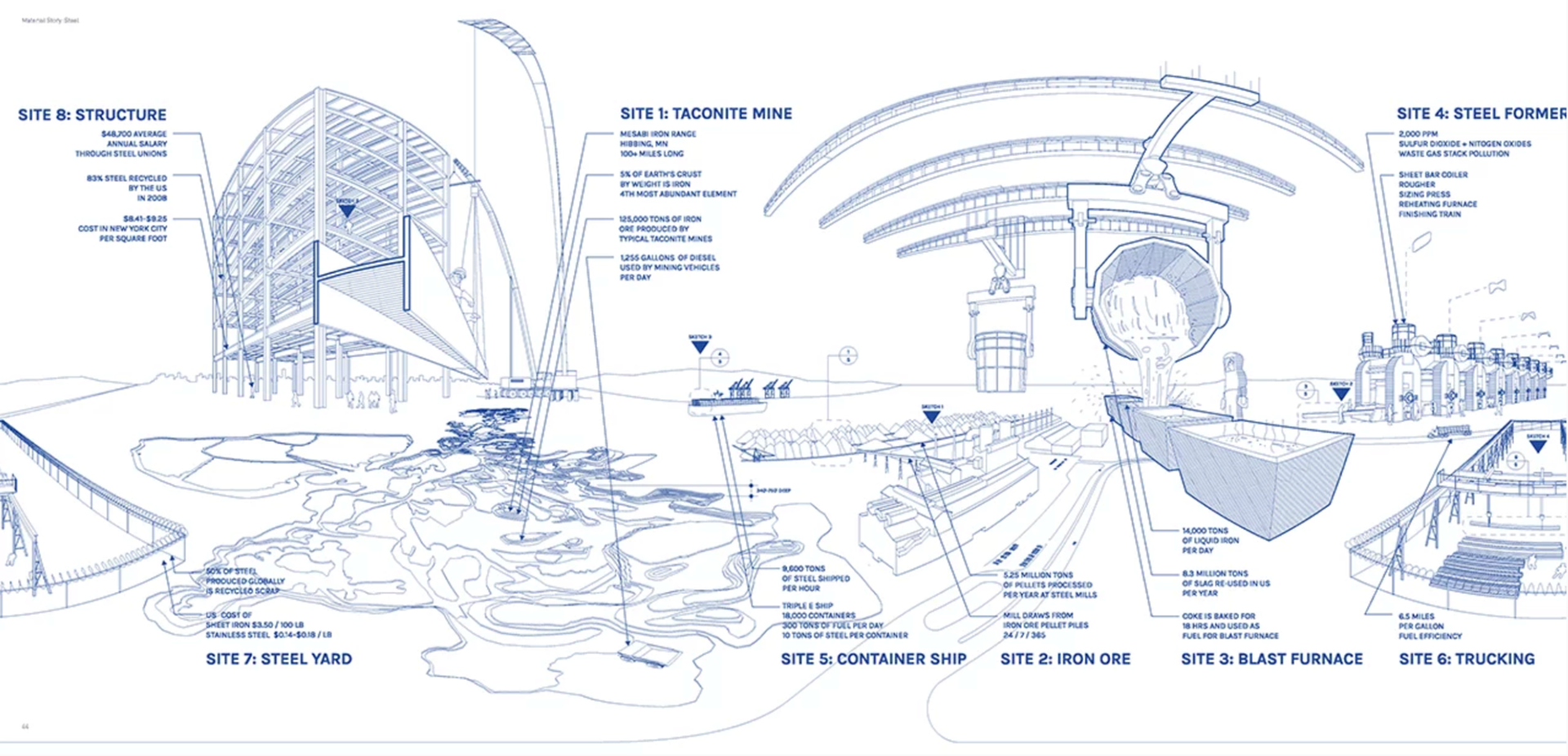
Credits: Material Stories: Steel, Embodied Energy and Design, D.Benjamin. Columbia University GSAPP
Cities are our future. They are the drivers of the global economy, centres of creativity, diversity, and interaction - and they are home to the majority of the global population. Cities cover only 3% of the earth’s surface, yet they consume 75% of global natural resources, making them effective places to address critical environmental and social challenges. A large part of the environmental impact of cities can be attributed to the Built Environment. Roughly 40% of all carbon emissions are related to this part of our economy. 10% can be attributed to embodied carbon, where 30% can be attributed to energy consumption.
Growing urban regions and consumption patterns combined with an extractive and wasteful economy create many adverse environmental impacts both inside and outside of our human habitats. Our linear economy is at the root of these challenges: core to this economic model is a fundamental disconnect between how we live our lives and do business, and what this means for the natural ecosystems that allow us to live happy, healthy sustainable lives.
In 2004 it was estimated that at the current rate of mining, we are left with 32 years of copper, 23 years of tin, and 21 years of lead (C.O’Donnell, D.Pranger). With the raw materials becoming scarce, in the near future, recycling and reusing will become an inevitable part of how architects, designers and engineers construct the built environment.
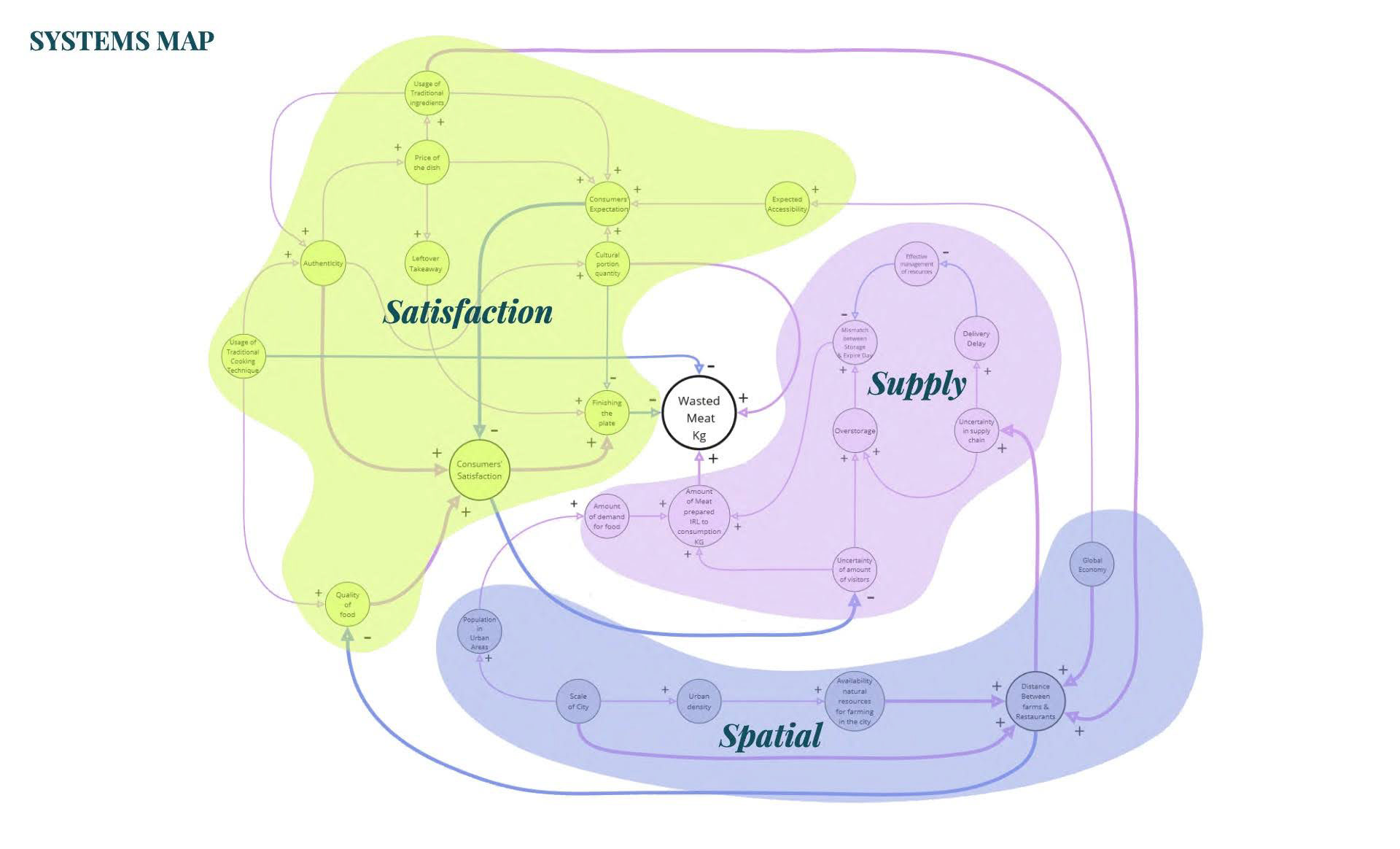
Credits: From Diversity to Sustainability by J.B.Saleh, Y.Wu, A.Najera, X.Can. IAAC 2022/23
Circular Matter Seminar focuses on two types of analysis needed to tackle these environmental challenges. At the first stage, it focuses on the creation of a Systems Map. This system map helps to identify root causes and leverage points for change on the basis of more intangible forces which steer our societies. Students dive into several frameworks, tools, and methodologies which help transform operations and drive long-term, meaningful sustainability progress and avoid unintended consequences and burden shifting. An example is the ‘7 Pillars of the Circular Economy’ framework by Metabolic, used by companies and cities globally. It is used as a holistic framework to assess trade-offs and understand the net positive impact of the design decisions and solutions.
Secondly, students map the materials and their respected embodied carbon coming in and out of a chosen case study. By analysing the process that construction materials go through, from the extraction of the raw materials, transportation, manufacturing, and assembling, to the end of life scenarios, and understanding the potential ways of shifting this linear thinking towards more circular approach, students are asked to highlight the global impact of the case studies in relation to the CO2 emissions and the environmental footprint.