Year: 2024
Location: Barcelona, Spain
Faculty: Nico Schouten, Gabriele Jureviciute, Kevin Matar
Students: Fleur Francesca Varel, Maheep Mouli Shashi, Geetham Pasumarty, Manuel Pardo, Prottay Roy Chowdhury, Alireza Shayan, André Arruda Navarro, Helen Dagne, Varun Sreenath, Avi Sharma, Soham Bhanushali
Location: Barcelona, Spain
Faculty: Nico Schouten, Gabriele Jureviciute, Kevin Matar
Students: Fleur Francesca Varel, Maheep Mouli Shashi, Geetham Pasumarty, Manuel Pardo, Prottay Roy Chowdhury, Alireza Shayan, André Arruda Navarro, Helen Dagne, Varun Sreenath, Avi Sharma, Soham Bhanushali
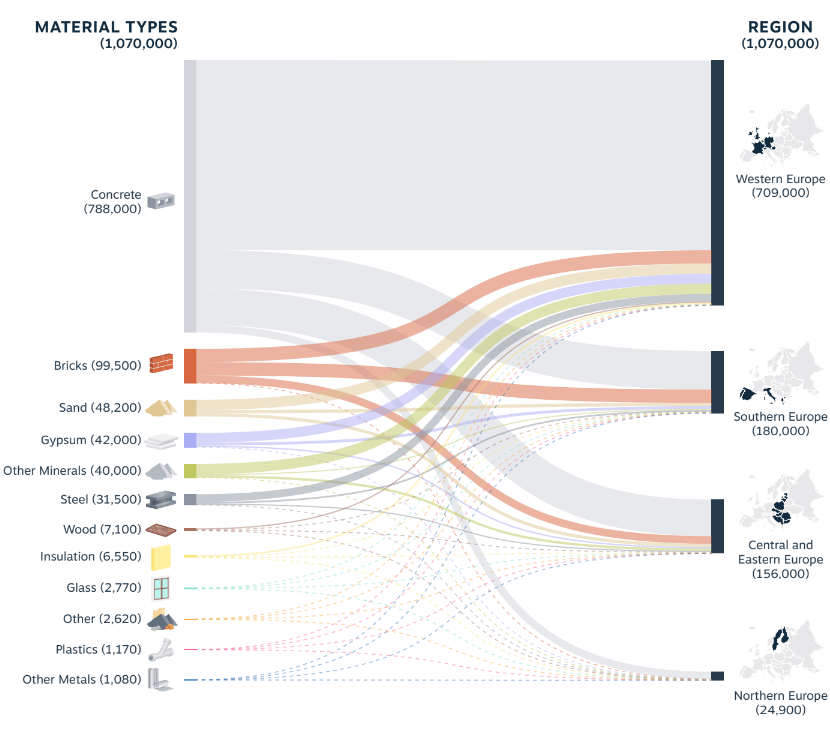
Credits: A material flow analysis that shows the use of construction materials per region, 2023, Circular Building Coalition
The Built environment is our home, but it is also a major driver of environmental impact. The European building sector consumes a staggering 1,070,000 ktons of material annually (Circular Building Coalition, 2023). Growing urban regions and consumption patterns combined with an extractive and wasteful economy create many adverse environmental impacts both inside and outside of our human habitats. Our linear economy is at the root of these challenges: core to this economic model is a fundamental disconnect between how we live our lives and do business, and what this means for the natural ecosystems that allow us to live happy, healthy sustainable lives.
In 2004 it was estimated that at the current rate of mining, we are left with 32 years of copper, 23 years of tin, and 21 years of lead (C.O’Donnell, D.Pranger). The excavation, production, and transportation of all these materials emit vast amounts of carbon. So much so, that if we keep constructing buildings in the same manner as we are now, we will pass our carbon budget for remaining within the 1.5C scenario as defined in the Paris-Agreement. With raw materials becoming scarce and the urge to reduce the carbon intensity of the materials used for the construction of new buildings the call for different design practices is bigger than ever. In the near future, carbon budgeting, recycling and reusing will become an inevitable part of how architects, designers, and engineers construct the built environment.
The Carbon-Based-Design Seminar focuses on integrating different parameters into design practices. Besides focusing on esthetical qualities and user demands students also design within a set amount of carbon that can be emitted during the construction of their project. In several short design sprints students are encouraged to reduce the environmental footprint of their design to fit within the amount of CO2 that is still left to be emitted.
In these sprints students explore the influence of secondary material use, reduction of highly impactful materials, and other design parameters (such as different typologies or reducing unnecessary components) that would influence the carbon emitted during the construction of a building. Students dive into several frameworks, tools, and methodologies which help drive long-term, meaningful sustainability progress and avoid unintended consequences and burden shifting.